Agentic Marketing
What Is Agentic Marketing? Explained Simply
What is agentic marketing? Agents plan, create and optimize marketing on their own. Here is how it works and why it matters for e-commerce brands.
· by Remo Girard · 8 min read

Agentic marketing means that agents built on artificial intelligence plan, create and optimize marketing tasks on their own. They work toward a goal set by a human. The human sets the guardrails and approves the results.
Here is the difference from the tools you use today: a chatbot gives you a piece of text when you ask for it. An agent receives a goal, breaks it down into steps, accesses your systems, carries out the steps and checks whether the result fits. In this article, you will learn how this works, where it is used today and why agentic marketing in e-commerce leads straight to agentic commerce.
What does "agentic" mean?
"Agentic" describes systems that act instead of just answering. The Eastern Switzerland University of Applied Sciences puts it this way: agentic artificial intelligence is the step from answering to acting. According to Bornet et al. (2025), an agent is a system that uses artificial intelligence and tools to act on its own in order to reach a goal (Eastern Switzerland University of Applied Sciences, in German).
Four capabilities work together:
- Perceive: collect data from different sources, such as analytics, your store or your customer relationship management system.
- Plan: decide which steps will reach the goal.
- Act: carry out those steps, for example writing copy, generating an image or adjusting a campaign.
- Reflect: evaluate the result and adjust the next run.
Only when all four come together do we speak of an agent. Without reflection, it is automation. Without action, it is an assistant.
Agentic marketing vs. marketing automation vs. generative artificial intelligence
These three terms are often mixed up, but they describe different approaches:
| Marketing automation | Generative artificial intelligence | Agentic marketing | |
|---|---|---|---|
| Trigger | Rule or event | A human's prompt | A human's goal |
| How it works | Fixed if-then workflows | One answer per request | Several self-planned steps |
| Handling the unexpected | Breaks on edge cases | Waits for the next request | Chooses between options |
| Learning | Only through manual changes | No learning beyond the request | Feedback flows into the next run |
| Role of the human | Build and maintain workflows | Write every request | Set goals, guardrails and approvals |

An example makes the difference concrete. In classic automation, the rule is: if someone downloads a white paper, send email A, then email B three days later. An agent, by contrast, sees what else the person looked at on the website, picks the most relevant next piece of content and adapts the follow-up to how the person responds.
Automation does not go away. For reliable, standardized processes, it remains the right choice. Agents take over where context and judgment are needed.
How an agentic marketing system works
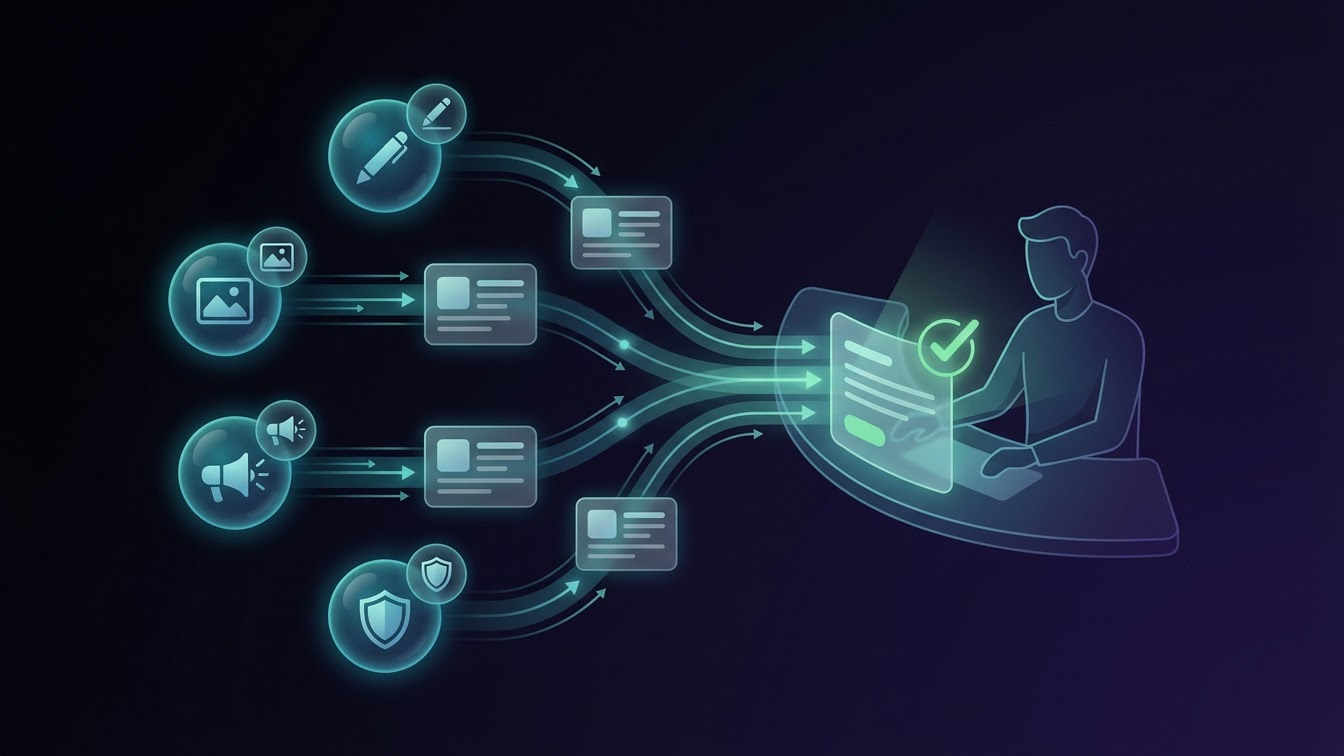
In practice, a single agent rarely works alone. Several specialized agents usually share the work, much like a marketing team. A typical workflow looks like this:
- Goal: The team defines what should be achieved. For example: "Create images and copy for 200 new products for the store, marketplaces and social ads."
- Context: The agents load product data, brand guidelines and previous results.
- Action: One agent creates the content, a second adapts it to each channel, a third checks brand and legal requirements.
- Feedback: Results are measured, for example by conversion or approval rate.
- Approval: A human reviews and approves before anything goes live.

At LumAIa, this final step is called the Campaign Engineer Gate. Marketing professionals validate the agents' output before it is delivered. You keep the speed of the agents without losing control.
Where agents are used in marketing today
Agents pay off wherever tasks recur and data is available. The most common use cases:
- Market and competitor monitoring: Agents track competitors, prices and trends and summarize what has changed.
- Content production: Research, drafting, optimization and channel adaptation run as a chain of agents.
- Product content in e-commerce: A single product photo becomes variants for the store, marketplaces, newsletters and social ads, aligned with brand guidelines.
- Campaign management: Agents monitor campaigns, spot anomalies and suggest changes to budget or audience.
- Reporting: Data from analytics, Search Console and customer relationship management is condensed and paired with recommendations.
McKinsey describes a five-step process for building these workflows. It starts with identifying which tasks agents can actually handle (McKinsey). Choosing carefully at this stage helps you avoid projects that look impressive but do not take work off anyone's plate.
Marketing for agents: the path to agentic commerce
So far, we have talked about marketing with agents. In e-commerce, a second perspective comes in: marketing for agents. Your customers are increasingly using agents that search, compare and buy on their behalf.
Search behavior is already shifting. When Google shows a summary generated by artificial intelligence, users click on a result in only 8 percent of cases instead of 15 percent (Pew Research Center, 2025). With the Agentic Commerce Protocol from OpenAI and Stripe, agents can complete purchases directly with the merchant (OpenAI).
For merchants, this means products must be just as understandable to machines as to people. Agents read product data, images and descriptions. Anything incomplete or inconsistent drops out of the selection. A study on Generative Engine Optimization shows that deliberately structured content can increase visibility in answers from artificial intelligence by up to 40 percent (Aggarwal et al., 2024).
This is where both perspectives meet. Agentic marketing produces the content that agentic commerce needs: complete, consistent and machine-readable product data and product images across the entire catalog. LumAIa's Product Asset Studio is built for exactly this. To learn how agents are changing the way people shop, visit our page on agentic commerce.
How autonomous are agents today?
"Autonomous" sounds like a system that does everything by itself. Reality is more nuanced. Bornet et al. (2025) describe five levels of autonomy, from rule-based automation to full autonomy. Most agents today operate at level 2 or 3 (Eastern Switzerland University of Applied Sciences).
If you lead marketing, that is good news. You do not have to choose between handing everything to agents or nothing at all. A step-by-step approach makes sense: start with agents that make suggestions, move to agents that act within fixed limits, and only then give them more room once results are stable.
Prerequisites and guardrails
Many agent projects fail not because of the agent, but because of its environment. Data quality, integration into existing workflows and team acceptance are often not ready yet. Before you start, review these points:
- Clean data: Product data, brand guidelines and customer data must be complete and up to date. Agents amplify whatever they find, including errors.
- Clear roles and approvals: Define what an agent may decide on its own and where a human has to sign off.
- Data protection: If you process personal data, privacy law applies. For Swiss companies, that is the revised Federal Act on Data Protection. Make sure company data does not flow into the training of third-party models.
- European Union Artificial Intelligence Act: If you sell into the European Union, the Artificial Intelligence Act applies to you as well, including transparency obligations for artificially generated content.
- Proof of origin: Label generated images in a traceable way, for example with provenance data based on the C2PA standard.
These guardrails do not slow you down. They are what make it possible to give agents more responsibility in the first place.
What changes for marketing teams
Agentic marketing does not make marketing teams obsolete. It shifts their work from execution to direction. Think with Google describes this change as moving from prompting individual tools to managing agents (Think with Google).
| Today | With agents |
|---|---|
| Set up campaigns manually | Define goals and budgets |
| Create content yourself | Set the brand direction and approve results |
| Gather data | Evaluate insights and make decisions |
| Maintain workflows | Define the roles and limits of agents |
What remains is the core of good marketing: strategy, judgment, taste and accountability. Agents take care of speed, repetition and monitoring.
Conclusion
Agentic marketing is the step from tools that wait for instructions to agents that work toward goals. For marketing teams, that means less execution and more direction. In e-commerce, there is a second side: if you use agents for your marketing, you produce exactly the product data and images that shopping agents need. That makes agentic marketing the foundation of agentic commerce, as long as data, approvals and legal requirements are properly in place.
Key takeaways
- Agentic marketing means agents plan, create and optimize marketing tasks on their own, working toward a goal.
- Unlike marketing automation, agents do not follow rigid rules. They choose between options and learn from results.
- In e-commerce, agentic marketing leads straight to agentic commerce, because products must also be readable for shopping agents.
- Humans stay accountable: they set goals and guardrails and approve the results.
Read more: To see how agents are changing the way people shop and what that means for your store, visit Understanding agentic commerce.
Frequently asked questions
Is agentic marketing just a buzzword?
The term is often used as a label for any tool built on artificial intelligence. A system only becomes agentic when it plans several steps toward a goal on its own, uses tools and learns from results. A text generator that answers a prompt does not qualify.
Which tasks are best for getting started?
Tasks that recur regularly and come with data: market monitoring, reporting, variants of product copy and product images, or adapting content to different channels. In these areas, quality is easy to check and the benefit is quick to measure.
How do you measure the success of agentic marketing?
With the same targets as before, plus process metrics. These include turnaround time per piece of content, the share of results approved without corrections, cost per asset and the effect on conversion or visibility in answers from artificial intelligence.
Do you need dedicated software?
Not necessarily. Agents can be built with general models and your own integrations. Specialized platforms come with preconfigured agents, connections to existing systems and built-in checks for brand and legal requirements. The deciding factor is how much development work your team wants to take on.